Logos and Meaning: A Shunting Yard
In Victor Frankl’s 1946 book Man’s Search for Meaning, a book about his struggle for survival in Auschwitz and other concentration camps, he speaks of life’s primary motivational force as the “will to meaning”.
This got me thinking about my own struggle to find meaning, especially in my creative work. Frankl, a psychotherapist, pioneered a therapeutic doctrine he called Logotherapy. The word logos, derived from Greek, denotes “meaning”. How ironic, I thought, as I had devoted so much of my life to making logos and in doing so, I had misplaced my own logos.
For me, there has always been a kind of suffocation in surviving as a freelance designer, what Frankl called existential frustration. Not the dramatic, crisis kind, but the slow erosion of self, the way you wake up one day and realise you’ve spent years building a life that isn’t yours. I didn’t hate my work and on the surface it had always seemed plausible. I just always felt like something was missing. It was a vacuum, a strange and conformist emptiness.
Frankl wrote that life’s primary drive isn’t pleasure or power, but the search for meaning, what he called the “will to logos”. Almost four years ago, I decided to leave my life in Durban behind in search of change, something new. On the surface it was a change of environment, of new challenges and opportunities, but underneath I suspected I was seeking meaning I had lost along the way.
When we set out on a creative career, many of us have an idea of the why that drives us, and this compels us forward. David Bowie said:
“Never play to the gallery… Always remember that the reason that you initially started working is that there was something inside yourself that you felt that if you could manifest in some way, you would understand more about yourself and how you coexist with the rest of society. I think it’s terribly dangerous for an artist to fulfil other people’s expectations, they generally produce their worst work when they do that.”
He often argued that being an artist requires a degree of “social dysfunctionalism”, a deep, perhaps irrational, urge to create, which he saw as a step beyond basic human survival.
I remember the exact moment I decided to leave my hometown of 33 years. It came to me like an epiphany, I just knew there was no other choice to make. I also knew this was a chance to do something I had always been secretly afraid of doing, to pursue my love of art.
Frankl called this the “defiant power of the human spirit”. Much like the concept of dharma, the work you’re meant to do, even when it scares you. Even when it doesn’t pay. Even when you’re not sure where the tracks lead.
I’m not there yet. Some days, the vacuum still pulls at me. But now I have a completely different environment, surrounded by incredible natural beauty and a burgeoning art scene. And for the first time, I feel a sense of logos.
I spent decades designing logos, logos for restaurants, businesses, cafés, for people who wanted to look like they had something to say. The irony wasn’t lost on me: a life spent creating logos, symbols of meaning for others, while my own felt strangely missing.
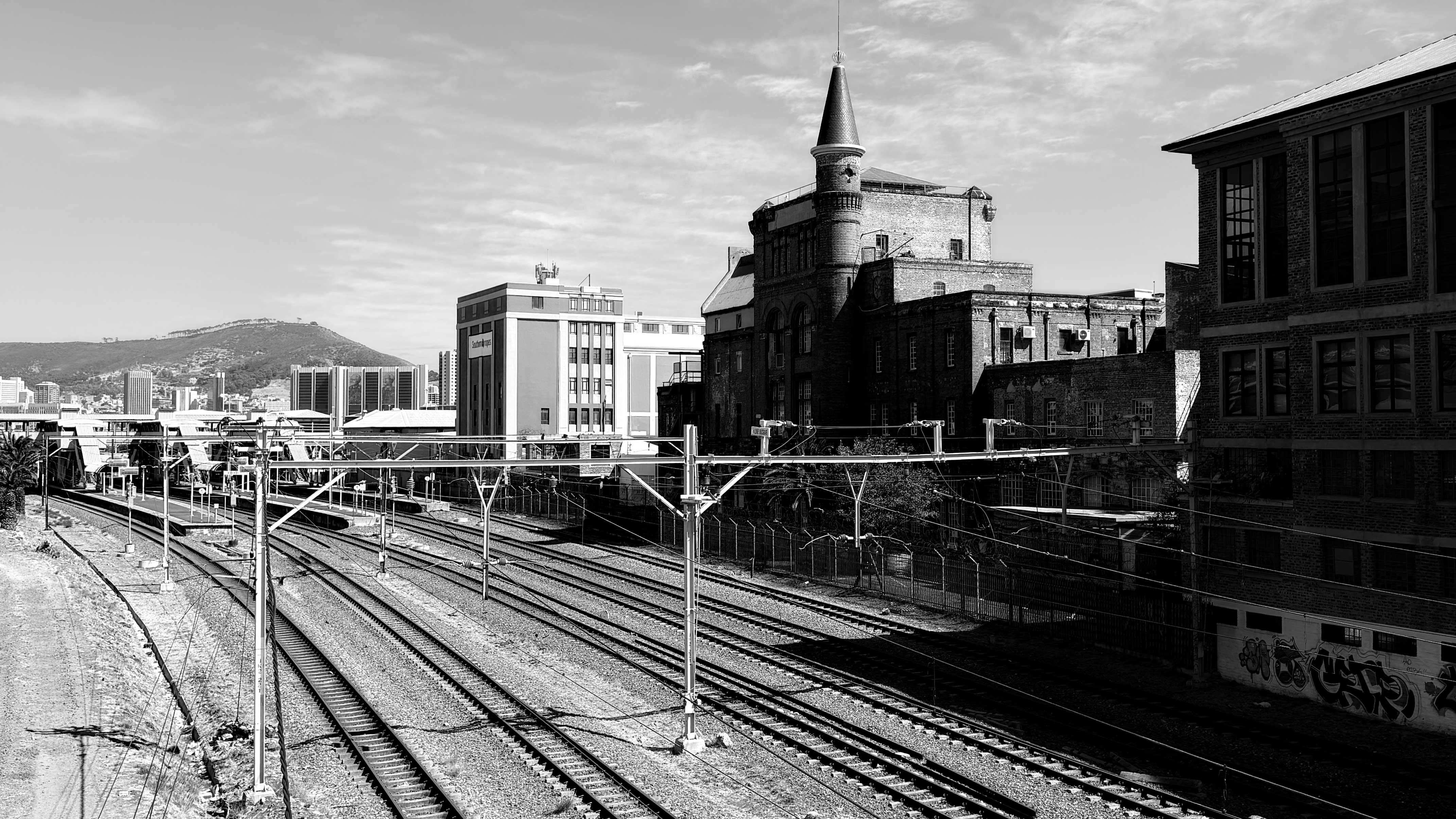
I used to think of my career as a line: studies, business, success. But careers and lives aren’t straight lines. They’re messy, loud, full of false starts and sudden stops. The scars are there, in the rust and the bent metal. The years I spent building a life that wasn’t mine. The clients who mistook my silence for agreement.
Frankl wrote that suffering ceases to be suffering the moment it finds meaning and as Nietzsche put it:
“He who has a why to live for can bear almost any how.”
I now know, while standing in an empty shunting yard on the foothills of Devil’s Peak taking these photos, that the search for meaning, no matter the cost, has changed my relationship with myself, my past and my future.
This is the first post in The Journal, a series of photo essays and reflections on art, meaning, and my hybrid creative journey.